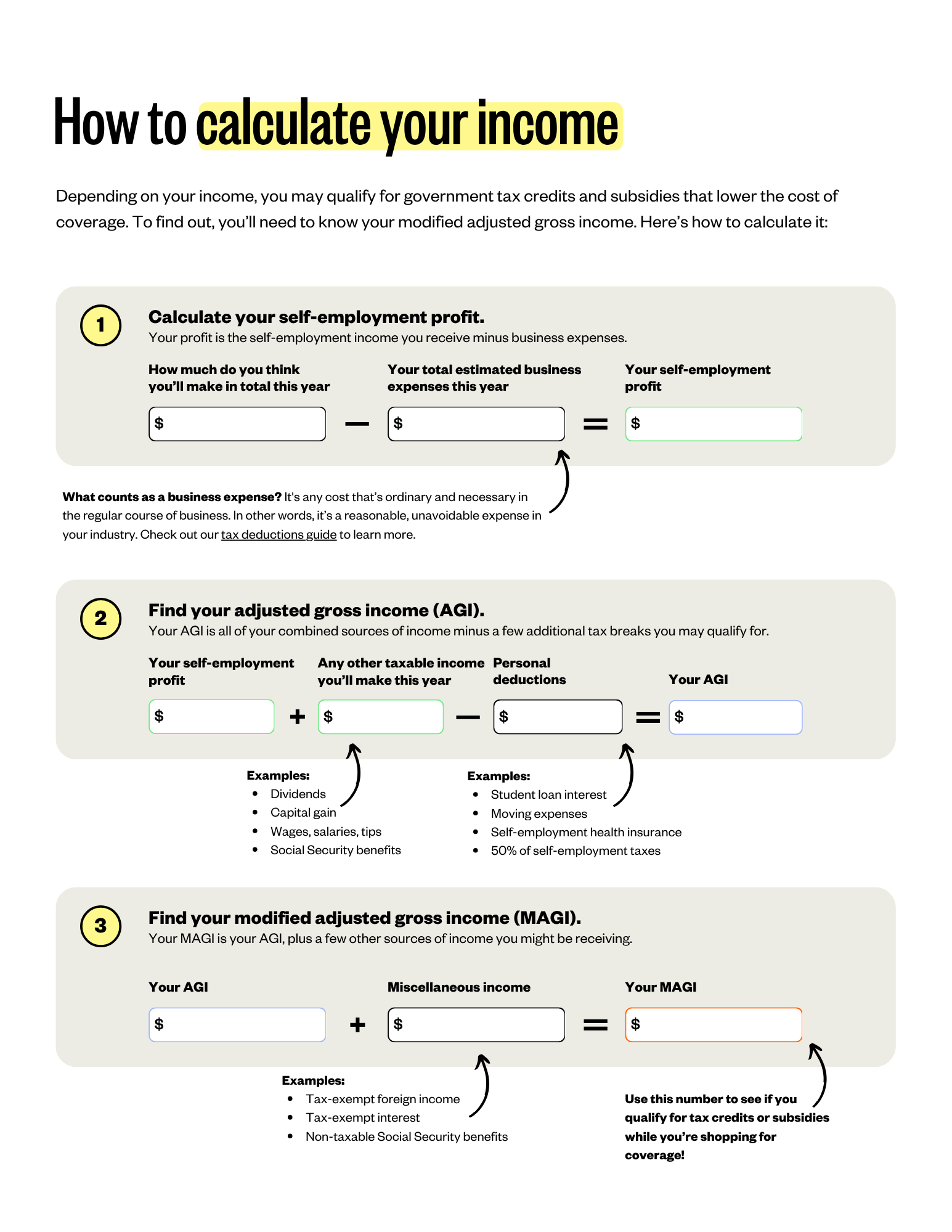
How to Calculate Your Income for Health Insurance
It may seem like health insurance is too expensive. But that’s not always the case — in fact, there are government tax credits that can lower the cost of your coverage significantly, and you qualify for these tax credits based on factors like your income and family size. To ensure you qualify for the most savings possible, though, it’s crucial to correctly calculate your income.
How affordable, you ask? Nationwide, about 87% of people who enrolled in marketplace coverage for 2026 got financial help through tax credits to lower their costs, according to the Centers for Medicare & Medicaid Services.
Almost 40% of people who get their insurance through Stride pay less than $50 per month.*
- Stride Health
In other words, accurately calculating your income can lead to some major savings on health insurance, whether you’re enrolling for the first time or switching health insurance plans to get better coverage or a more affordable price. Still, we get it — predicting income can be pretty tricky when you’re self-employed. When you set your own hours, it’s hard to predict what those hours will be for an entire year. And for self-employed workers, business and personal deductions play a huge role in calculating income: The more business deductions you have, the lower your income.
Here, learn how to calculate your modified adjusted gross income (MAGI), which is the number you’ll use to determine if you qualify for tax credits (and if so, how much you’ll save). Plus, get a printable worksheet to calculate your MAGI with ease.
Where this number comes from
Let’s talk a bit about how to calculate your MAGI to better predict your total expected taxable household income.
Finding your business profit
For example, let’s say you know that you received about $51,000 from driving for Uber last year, so you use that number as your estimated income for 2027. Not bad, right?
But you spent some of that money on work-related expenses like cell phone data, passenger goodies, car cleaning, mileage, and a whole lot more. That means your true income is lower than $51,000. That’s why the income amount that we’re looking for is your MAGI (Modified Adjusted Gross Income), not how much you’ll receive from Uber in total next year. So when you’re tallying up your income, you should include your business profit. This is your total Uber income minus expenses.
The IRS calls these deductible purchases “ordinary and necessary expenses,” because they’re either ordinary for your industry, or they’re necessary in order to do your job. Every time you incur an ordinary and necessary expense, you can subtract that amount from your business income.
So you’ve made $51,000, but you’ve spent $2,000 on parking fees, water bottles for passengers, a Spotify subscription, and your cell phone bill. You’ve also been tracking your mileage, and know you’ve driven about 13,800 miles this year for rideshare. With the standard mileage deduction, you get $0.725 for every mile that you drive for your self-employment job, so you get another $10,000 tax deduction on top of that $2,000.
Now, your business profit is $39,000.
If your self-employment job is your only source of income, you would use your business profit as your gross income (the sum of all of your sources of income).
Insider tip
When you’re predicting what your business deductions will be, you need proof! You might be asked to submit proof of income with your health insurance application. If you’ve been keeping track of your business deductions all year (via the free Stride app , for example), and you expect to work about the same amount in 2027 as last year, you can use the documentation for those deductions as proof.
How to calculate your adjusted gross income (AGI)
AGI is all of your combined sources of income minus the stuff that you shouldn’t be taxed on. The IRS allows you to reduce your total taxable income with personal deductions, which are expenses that you have to pay that shouldn’t be included in your AGI.
Adjusted gross income = Total income - personal deductions
A few examples of personal deductions are:
Student loan interest
Self-employed health insurance payments
IRA contributions
50 percent of self-employment taxes
Health Savings Account (HSA) contributions
Expenses like the ones above should be subtracted from your gross income.
So let’s say your business profit is $39,000 like we calculated above. Let’s also say you make IRA contributions of $5,200 every year. Because IRA contributions are a personal deduction, you can subtract the amount that you pay in contributions from your gross income. Now your AGI is $33,800!
Insider tip
If you’ve filed taxes as a self-employed worker before (complete with business deductions), and expect to work about the same amount in 2027, the AGI you reported on your last tax return is the best estimate you can find.
How to calculate your MAGI
MAGI is your AGI, plus a few other additions and subtractions (like non-taxable Social Security benefits, tax-exempt interest, and foreign income). In most cases, your AGI is the same as your MAGI.
MAGI = Adjusted gross income + A little something extra
So if your AGI is $33,800, and you don’t need to add in the forms of income listed above, you’ll calculate your income (aka MAGI) at $33,800.
Your health plan price will vary because you’ll have your own MAGI, zip code, household size, and other factors.
Here’s our point: The money you earn is not the same as your MAGI. So when you take time to calculate your income for health insurance correctly, you’ll make sure you don’t overpay for health insurance.
That’s how business deductions can come into play when 1099 paychecks are your only source of income. But what happens when you have more than one independent worker job, or have W-2 income as well?
Calculating your income with multiple 1099s
The process of calculating your income is more or less the same when you have more than one 1099, but it involves a bit more math.
For example: You’ve been working for Postmates for a few years and started driving for Uber a few months ago to make some extra cash. You know you’ll keep driving for Uber all year next year, but don’t have a year’s worth of paychecks to predict how much you’ll make in 2027, let alone how much you’ll subtract in business deductions.
No problem! We can estimate a year’s worth of income and deductions based on a few weeks or months of driving information.
If you have records of 1) how much you’ve made from Uber, and 2) how much you can deduct from that income, you can take an average income total and deduction total for a week or month and multiply it to equal one year of working.
Let’s say you typically make $500 per week with Uber, and you know that you typically spend $50 per week on deductible expenses. You also have been tracking that you drive about 300 miles per week, which comes out to a $217.50 weekly deduction (.725 standard mileage rate for 2026 x 300 miles).
That means your typical weekly business profit is $232.50 ($500 - $50 - $196.50).
You can take that number and multiply it by the 52 weeks in 2027 to find your projected 2027 business profit! Now you know you’ll make about $12,090 in net profit from Uber.
What if I have W-2 income too?
We’ve got your back. If you work part-time or full-time at a job, your gross income is calculated a little differently because your employer will withhold some of your taxes for you. That means that the money you take home isn’t necessarily the number to include in your income calculation.
Because gross income is your income before taxes, you’ll need to use your hourly rate to estimate your gross income, since that’s your income before your employer has withheld any taxes.
So let’s say you expect to make about $300 per week in business profit from Uber next year, and expect to work about 20 hours per week at a local restaurant earning a minimum wage of $7.25 per hour.
Your weekly income from the restaurant would be $145 ($7.25 x 20), and your weekly profit from Uber would be $300, earning you a total of $445 per week. Multiply that by 52 weeks, and you’ve got your 2027 gross income of $23,140.
You know your MAGI. Now how do you figure out if you qualify for tax credits?
You’re one step away from seeing how much you could save on health insurance! Stride makes it simple: Use our subsidy calculator and input your MAGI to see what you could save.
When you’re ready to put those savings to use and get covered, Stride makes it easy to find the right plan at the best price — without all the stress of search countless plan options on confusing government sites. Our customizable search tool recommends the best plans for your needs, simplifies your decision with filters and side-by-side comparisons, and automatically applies all the savings you’re entitled to. Get started by entering your ZIP code below.